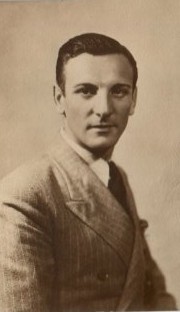
 Webster as a young man in the early thirties.
WEBSTER BOOTH
EARLY DAYS IN BIRMINGHAM AND LINCOLN
Leslie Webster Booth was born on 21 January 1902 at 157 Soho Road, Handsworth, north of Birmingham.
 Soho Road, Handsworth - early twentieth century.
 Collage of Lincoln Cathedral : Photographs and collage by: Charles S. P. Jenkins.
The youngest son of ladies’ hairdresser, Edwin Booth, in a family of three sons and three daughters, he possessed a voice of outstanding quality, and at nine years of age, his voice elevated him from the local suburban Church choir in Edwardian Birmingham to the choir stalls of Lincoln Cathedral under the direction of Dr George Bennett.
Collage of Lincoln Cathedral : Photographs and collage by: Charles S. P. Jenkins.
The youngest son of ladies’ hairdresser, Edwin Booth, in a family of three sons and three daughters, he possessed a voice of outstanding quality, and at nine years of age, his voice elevated him from the local suburban Church choir in Edwardian Birmingham to the choir stalls of Lincoln Cathedral under the direction of Dr George Bennett.
Dr Bennett was a fine musician, but a stern taskmaster who insisted that choristers sang with flat tongues: he was not averse to flattening an errant tongue with the ever-ready ruler. Just as today Cathedral choristers are disciplined hard-working musicians, so they were in the first decades of the twentieth century too. Christmas holidays for the choristers commenced only after the Christmas Eve services.
Lincoln was a good training ground for young Leslie Booth. Although he did not make great progress on the piano and thus did not advance to the organ he longed to play, he learnt to sight-read vocal lines with ease. This ability stood him in good stead as a professional singer, especially at recording sessions. He went to HMV studios to record six or eight songs at a session. He sight-read through the selected songs, recorded them in one or two takes, and then forgot them at the end of the session. Years later when people appeared before him clutching one of his old records, assuring him of their great attachment to the particular song, he often had no recollection of making it in the first place.
After his voice broke, he studied at Aston Commercial School and was set for the steady job of an accountant, but at fifteen, he began his vocal studies as a tenor with Dr Richard Wassell, the musical director at the Midland Institute in Birmingham. At that time, Webster was an avid Aston Villa supporter, and he was a good enough goalie to be offered a place with the Villa Colts. He was torn between the equally glamorous callings of football and singing. Luckily singing won.
With his great natural vocal gifts, his striking looks and winning personality, singing came easily to him. Soon he was singing at concerts in the Midlands and Wales, by this time a tall, imposing young man, who realised that appearance and stage presence were nearly as important as his exceptional voice. Although he had perfect diction in song, he had to take elocution lessons to smooth the Brummy intonation from his speech.

His adult voice was a distinctive lyric tenor, with a wide range and a baritonal quality on the lower notes. His diction was clear and lacked the idiosyncratic pronunciation and bleating quality of many of his contemporaries, which marked them as refined English singers, not quite able to compete with their more virile Italian and German counterparts. In my opinion, Heddle Nash and David Lloyd were the only two British tenors of Webster Booth’s generation who had comparable voices, acceptable in world terms, as well as British. Unfortunately opera singing was poorly paid in those days, so singers without a private income had to diversify their talents if they wished to make a decent living.
RECORDINGS
Webster was contracted to HMV for over twenty years and recorded more than a thousand solos, duets, trios and quartets His recordings – more than 1000 – covered a wide spectrum of musical works: ballads, show songs, lieder, opera and oratorio – all in English, as was the custom in those days.
His lighter recordings include selections from Ivor Novello musicals with Helen Hill, Olive Gilbert and Stuart Robertson; Theatreland at Coronation Time with South African soprano Garda Hall, Sam Costa and Stuart Robertson; excerpts from Snow White with Nora Savage, conducted by George Scott-Wood, the composer of Shy Serenade.
In the early days of his recording career he was often unacknowledged in the credits. He sang in recordings of the HMV Light Opera Company, along with singers such as George Baker, Essie Ackland and Alice Moxon, all of whom remained equally anonymous in highlights from musicals such as MERRIE ENGLAND, medleys of Scottish songs or the vocal gems of the Co-optomists.
Watch on YouTube:.Merrie England gems by HMV Light Opera Company
He was the vocal refrain on records featuring Carlos Santana’s Accordion Band (alias Harry Bidgood) on the Regal Zonophone label, and on an HMV record of Chappell Ballads with Jack Hylton’s Band. He made many recordings with Ray Noble and the HMV house band, entitled The New Mayfair Orchestra. He recorded songs with Fred Hartley’s Quintet, where his name was actually included on the record label. Even when he was quite famous he formed part of a distinguished male chorus, which included George Baker, for a series of songs with Peter Dawson as soloist. Among these anonymous male chorus recordings are Waltzing Matilda, and Stanford’s Sea Songs.
When he went to a recording session, he was presented with the music for songs to be recorded at the session. If he did not know them already, he would sight read them through and make the recordings immediately, usually getting everything right after four or five takes. No wonder then that twenty or thirty years later he did not always remember having made some of the recordings in the first place.
His recordings of the late 1930s and 1940s encompassed oratorio, opera and ballads, as well as duets with Anne. The more serious works were often under the baton of Malcolm Sargent, Laurance Collingwood, Basil Cameron or Warwick Braithwaite with the Hallé, the Liverpool Philharmonic or the Royal Philharmonic Orchestras. His recordings with piano accompaniment were nearly always with the eminent accompanist Gerald Moore.
Webster told the story of a particular recording session with Gerald Moore. They had one more song to record before the session ended. That song was Phil, the Fluter’s Ball. Gerald Moore suggested that they should see how fast he could play and how fast Webster could sing the song with clear diction. This was no problem for a singer who had spent four years performing Gilbert and Sullivan with the D’Oyly Carte Company.
Watch on YouTube: Phil, the Fluter's Ball
At the beginning of the Second World War, he recorded The Lost Chord at the Kingsway Hall in London, accompanied by the organist Herbert Dawson. As they were reaching the end of the song, the All Clear siren sounded, and so they had to redo the recording to cut out the sound of the All Clear. There had been no air raids at that early stage of the war, so presumably the sirens were being given a trial run. The blitz was yet to come and would destroy Webster’s favourite concert hall, the Queen’s Hall.
His oratorio recordings are particularly fine. The solos in SAMSON from the moving recitative O loss of sight and the following aria, Total Eclipse to the fiery Why does the God of Israel sleep?, with its unrelenting Handelian runs, demonstrate how easily he moved from one mood to another, always singing with flawless technique and clear diction. He made recordings with other distinguished singers of the day in operatic ensembles, such as the quartet from RIGOLETTO, with Noelle Edie, Arnold Matters and Edith Coates to the trio from FAUST with Joan Cross and Norman Walker. He sang duets with soprano Joan Cross and baritone Dennis Noble from LA BOHÈME and the Miserere from IL TROVATORE with Joan Cross. He recorded duets with the baritone Dennis Noble from the Victorian and Edwardian Excelsior and Watchman, What of the Night? to the brilliant extended scene in Rossini’s THE BARBER OF SEVILLE. He recorded the duet in MADAME BUTTERFLY with Australian soprano Joan Hammond. He also sang excerpts from CARMEN with the Sadler’s Wells chorus and orchestra, with Nancy Evans, Anne’s friend from Liverpool, as Carmen.
CONCERT AND OPERATIC WORK
Webster made his début at the Promenade Concerts in 1936 under Sir Henry Wood, and was in increasing demand as tenor soloist in oratorios. In those days the Promenade Concerts were held at the Queen’s Hall. This concert hall, with its sympathetic acoustics, was always his favourite concert hall.

By 1938 he was a respected and well-known concert singer, but he agreed to audition like an unknown for the Covent Garden International Opera Season before Sir Thomas Beecham, who was joined by his companion, Lady Cunard, at the audition. The pair sat in the middle of the empty auditorium and chatted to one another during his audition arias. Despite their apparent inattention to his efforts, he was offered minor roles in THE MAGIC FLUTE and DER ROSENKAVELIER. The pay was poor; the rehearsals were unpaid. Although he made many operatic recordings, this was his last venture into Grand Opera at Covent Garden or any other opera house, apart from several performances for Lilian Baylis at Sadler’s Wells.
Two years after their marriage and duet partnership, Anne and Webster became highly popular duettists and their fame reached its zenith during the war. Although he was now part of a successful variety act, he was still in great demand as an oratorio singer with fellow soloists such as Isabel Baillie, Gladys Ripley, Muriel Brunskill, Harold Williams, Dennis Noble, Norman Walker and Keith Falkner. Handel’s Messiah, Jephtha, Samson, Solomon, Acis and Galatea, Judas Maccabeus and Haydn’s Creation were only a few of the oratorios in which he sang. Webster was a noted Gerontius in Elgar’s THE DREAM OF GERONTIUS, and it is a pity that he was not given the opportunity to record this work. On 10 May 1941, he sang in a daytime performance of this oratorio at the Queen’s Hall, conducted by Sir Malcolm Sargent.
Several hours later the hall was destroyed in an air raid.
In 1951 Webster’s contract with HMV was not renewed although he was still in fine voice at the age of forty-nine. Before the war he had sung Coleridge Taylor’s HIAWATHA'S WEDDING FEAST in full Native American costume, and in 1955 on the occasion of Sir Malcolm Sargent’s birthday concert, Sir Malcolm particularly requested that he should be the tenor soloist in the same work.
Jean Collen (Originally published in
Ziegler-Booth blog in 2005.
Join:
The Webster Booth-Anne Ziegler Appreciation Group on Facebook





