
Webster Booth and oratorio
Although Webster Booth is remembered today as a romantic duettist in partnership with his third wife, Anne Ziegler, he told me that oratorio had given him the greatest satisfaction in his singing career. He was certainly a renowned oratorio singer in his day but this has been forgotten by most people who know more about him singing We’ll Gather Lilacs than tenor solos in various oratorios.
Two of my most cherished possessions are Webster’s Messiah and Elijah scores. The Messiah score had belonged to his father, Edwin Booth, whose name is written in the score, followed by Webster’s own name.
.
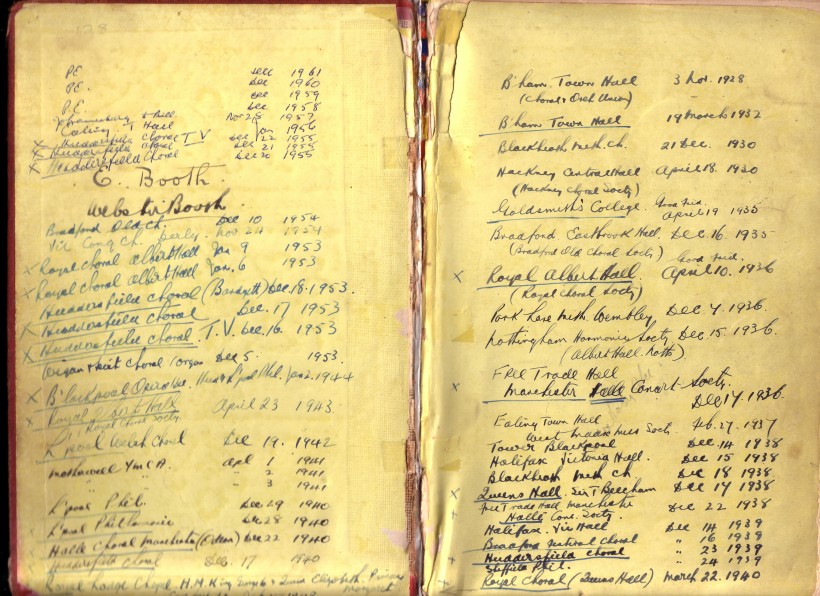
Webster's Messiah score
On the two front pages, he listed some of his Messiah dates from 1928 when he sang at the Birmingham Town Hall on 3 November 1928 with the Choral and Orchestral Union, to performances of various oratorios in Port Elizabeth, Eastern Cape, South Africa with Robert Selley at the Oratorio Festivals there in 1961. The list includes a performance at the Royal Lodge Chapel on 15 February 1948 in the presence of King George VI, Queen Elizabeth and Princess Margaret, performances with the Huddersfield Choral Society, the Royal Choral Society and the Hallé Concert Society. Several Good Friday Messiahs at the Albert Hall where the entire work is performed without any cuts are listed. His first Good Friday Messiah was on the 10 April 1936 when he was 34 years of age. The Royal Choral Society concerts were usually with his champion, Malcolm Sargent as conductor, but he also sang with Sir Thomas Beecham at the Queens Hall on 17 December 1938.

He sang in many performances of Elijah, The Creation, Joshua, Judas Maccabeus, The Creation and Elgar’s Dream of Gerontius. It was after an afternoon performance of this last work at the Queen’s Hall on 10 May 1941 that this beautiful hall, Webster’s favourite concert hall, was destroyed by an incendiary bomb that night. Webster preferred Handel to Bach, but I see that he did sing in a performance of the latter's Christmas Oratorio in South Africa in 1960. 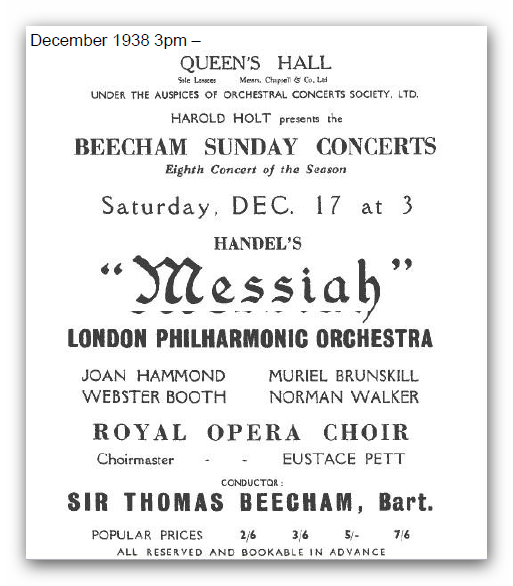
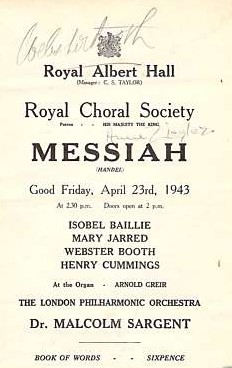
Another Good Friday Messiah in April 1943
I think it is sad that he did not make a recording of the Dream of Gerontius as he was renowned for his performance in this work. Neither did he take part in complete recordings of Messiah or Elijah.
When I was studying with him and Anne Ziegler I learnt the part of the Angel in The Dream of Gerontius and he sang the tenor part with me – how I wish I had a recording of it now! He sang in the first performance in South Africa of the work with the young Keith Jewell, Cape Town’s city organist (then aged 27) in 1957, the year after the Booths arrived in South Africa.
People in South Africa were inclined to think that the Booths had been out of favour in the UK and that was the reason why they moved to Johannesburg in 1956. This was far from the case. Admittedly their recording contract with HMV had been cancelled in 1951 and I have never been able to work out why the contract was cancelled as they were both in excellent voice at the time. But they had plenty of theatre, television, radio and concert engagements in the 1950s.
Webster sang his last Messiahs with the Huddersfield Choral Society in December 1955 and January 1956. They moved to South Africa because of increasing problems with the Inland Revenue rather than because they were not as popular as before.
Anne Ziegler sang in exactly one first class performance of Messiah in Blackpool in January of 1944. Doctor Malcolm Sargent (as he was at that time) conducted the performance with the Huddersfield Choral Society.
 1944 Blackpool Messiah
As a thirteen-year-old girl, I heard Webster and Anne sing in a performance of Messiah at St James’ Presbyterian Church which was then situated in Mars Street, Malvern, Johannesburg. Even at that young age, I was aware that it must have been a come-down for Webster to be singing this work in a suburban church in South Africa after he had been singing at the Albert Hall not very long before.
While Anne sang in the performance at St James under the musical director of the main Presbyterian Church in Johannesburg, Drummond Bell, she was not asked to sing in more important oratorio performances, such as the one at the Johannesburg City Hall a month later, or with Robert Selley at the Port Elizabeth Oratorio Festival.
Webster's oratorio recordings include the arias from Handel's Messiah, Judas Maccabeus, Samson, and Acis and Galatea, Mendelssohn's Elijah and St Paul, and Haydn's Creation.
Jean Collen
12 July 2017.


